SAINTS FOR ALL SEASONS
THE FRANCISCAN PROTOMARTYRS
By Brother Patrick
Pope Francis once said: “The whole of humanity, now more than ever, needs the good news of peace, and every Christian is called to announce it and share it.” Giving witness to our faith is the core and essence of our mission to live the Gospel, share God’s love, and rebuild the Church. But fulfilling the call to witness is not easy.
Over long years, countless men and women of faith have dedicated their lives to the Good News of the Poor Christ. Some of these disciples, some of these witnesses, some of these brothers and sisters in faith lost their lives in God’s service. We call them martyrs. According to the Catechism of the Catholic Church (CCC): “Martyrdom is the supreme witness given to the truth of the faith: it means bearing witness unto death (CCC 2473).” According to Lumen Gentium (1964): “The Church considers martyrdom an exceptional gift and the fullest proof of love (42).” And according to Pope Benedict XVI: “The martyr follows the Lord to the very end, freely accepting death for the salvation of the world in a supreme test of love and faith (8-11-10).”
Few among us will be called to offer this exceptional gift, this supreme witness. Fewer still seek it. But for centuries, however, martyrdom was the ultimate goal of aspiring saints and everyday disciples. Francis of Assisi longed for martyrdom and shared this desire with his friends and followers. Among these were Berard of Carbio and his companions: Otho, Peter, Adjutus, and Accursius. These five friars traveled from Assisi to Spain where they faithfully preached the gospel, but failed to inspire any conversions to faith.
The five friars traveled next to the Kingdom of Morocco in North Africa because Berard was fluent in Arabic. He and his friends preached with passion and eloquence. But once again, their words and witness did not prompt a single conversion.
Berard and his companions were considered crazy by the royal court. At the king’s orders, the friars were escorted back to Spain, but they soon returned and resumed their missionary activity. As punishment, the king handed them over to a crowd that beat and humiliated them. The friars suffered this torment with grace and humility.
Although their faith and fidelity impressed the king, he arrested the friars. He offered them honors and riches. He offered them wives and sensual pleasures. But Berard and his companions declined. The king then gave them a final choice. Renounce the Christian faith or face execution. When the friars chose their faith, the king himself beheaded them with a scimitar. In Islamic culture, this long, curved blade is known as the Sword of God, the Sword of Truth, and the Sword of the State. The heads and bodies of Berard, Otho, Peter, Adjutus, and Accursius were thrown into the street. The people paraded the remains through the city, then left them to rot on a dunghill.
A violent storm suddenly erupted. Fearful and superstitious, the people ran away. Watching from a distance, however, a group of Christians gathered up the remains. Already appreciating the holiness of the five martyrs, these Christians placed their heads and bodies in two silver caskets. They were transported secretly to Portugal. Prince Peter, Duke of Coimbra, presented the relics to the king and queen. The relics of Berard and his companions were soon transferred with reverence and solemnity to the Monastery of the Holy Cross.
When Saint Francis heard of the execution, he cried out with joy: “Now I have five faithful friars minor!” Meanwhile, a young priest who prayed before the relics was inspired to join the Order of Friars Minor. We know him now as Saint Anthony of Padua (1195-1231). Saint Berard & Companions were canonized in 1481. Their feast is celebrated on January 16th, the anniversary of their deaths. More than eight centuries later, the relics of Saint Berard & Companions, also known as the Franciscan Protomartyrs, are still venerated by pilgrims from all around the world.
Last fall, Pope Leo XIV presided over an ecumenical prayer service on the Feast of the Exaltation of the Holy Cross. He paid tribute to 1,624 Christians who died as martyrs between 2000 and 2025. The Holy Father said: “Their martyrdom continues to spread the Gospel in a world marked by hatred, violence, and war…Even though they have been killed in body, no one can silence their voices or erase the love they have shown. Their witness lives on as a prophecy of the victory of good over evil. Theirs is an unarmed hope. They bore witness to the faith without using weapons of force and violence, but rather by embracing the meek and hidden power of the Gospel. May the blood of these many witnesses hasten the arrival of the blessed day when we will drink together from the same cup of salvation (9-14-25).” In this spirit of faith and sacrifice, we pray:
A Prayer for the Feast of Saint Berard & Companions
Most High God,
you call us to give witness
to the Gospel of the Poor Christ
in thought, word, and deed.
Through the prayers of Saint Berard & Companions:
Help us to grow in faith, hope and love.
Help us to grow in courage and commitment.
Help us to forge bonds of fraternity and solidarity
among all peoples in all places.
By the example of Saint Berard & Companions:
Help us to live the Gospel,
share God’s love, and rebuild the Church
without counting the cost,
without fearing the consequences.
We ask this through Jesus,
our merciful redeemer, friend, and brother
who lives, loves, and reigns
with you and the Holy Spirit;
God forever and always. Amen.
Glory to the Father, to the Son, and to the Holy Spirit; as it was in the beginning, is now, and will be forever. Amen. Saint Berard & Companions, pray for us! Saint Francis of Assisi, pray for us! Saint Clare of Assisi, pray for us! Saint Anthony of Padua, pray for us! Our Lady of the Angels, pray for us! Pope Francis, pray for us!
ABOUT THE AUTHOR
Brother Patrick Garvey is co-founder and spiritual director of the Assisi Project. He is a graduate of the University of Southern Maine, Saint John Seminary, and the Catholic University of America. He is a writer, spiritual director, retreat leader, and university lecturer. He also serves as an Associate Minister in the Catholic Community of Gloucester & Rockport in Massachusetts. On October 3, 2023, the Feast of the Transitus of Saint Francis of Assisi, Brother Patrick was consecrated as a diocesan hermit by Bishop Mark O’Connell, Vicar General of the Archdiocese of Boston. For more information about the Assisi Project and our ministries with adults of all ages and backgrounds, please contact Brother Patrick at brpatrick@assisiproject.com.
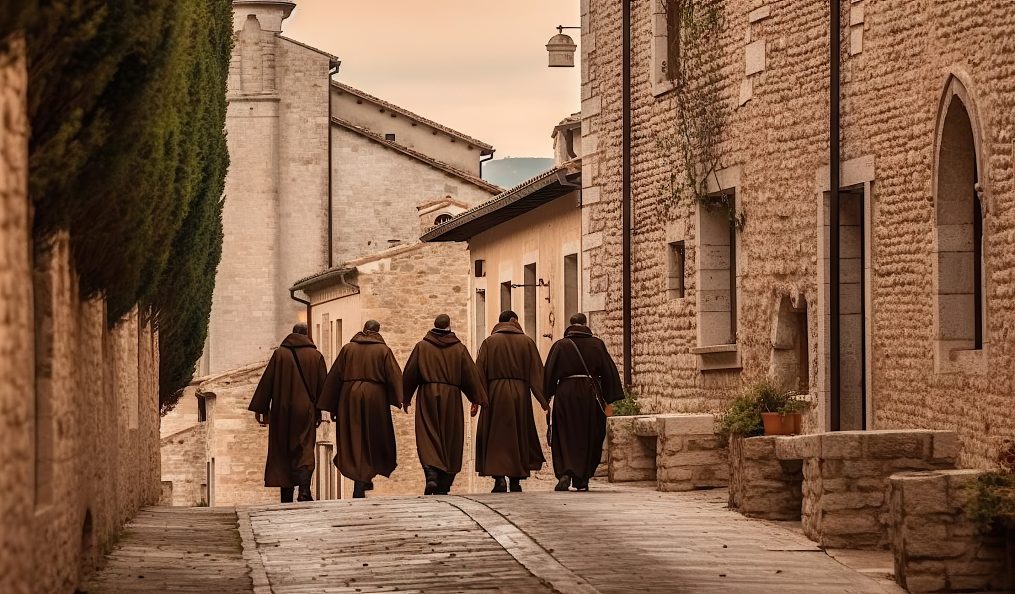
Art Credit: Asphoto777 – 279599141 – Dreamstime
__________
ABOUT US
Founded in 2007, the Assisi Project is a Fellowship of Franciscans in Spirit with friends and followers throughout the world. We are dedicated to helping Christian believers of all ages more faithfully live the Gospel of Christ in the spirit of Saint Francis and Saint Clare of Assisi. We are also dedicated to promoting a devotion to Pope Francis (1936-2025) as a patron of peace, mercy, and fraternity in our sick and suffering world.
The Assisi Project is a non-profit, tax exempt charitable organization. Please support our ministry via Pay Pal (see link below) or mail a tax-deductible donation to the Assisi Project, Post Office Box 3158, Gloucester, Massachusetts 01931-3158. The Assisi Project Podcast is produced by the Assisi Project, Inc. Copyright 2025. All rights reserved. May the Lord give you peace!
Support us via PayPal
Follow us on BlueSky
Follow us on Instagram
This Week’s Homepage
In Memory of Renee Nicole Good
 The Assisi Project