PILGRIMS OF HOPE
SOPHIE SCHOLL AND THE WHITE ROSE
By Brother Patrick
In 1993, Richard von Weizsacher, the President of Germany, reflected on the example of a group of students and academics who advocated for non-violent resistance to Adolph Hitler and German Nazism. President Weizsacher said: “Every person is responsible for what he does and for what he allows to happen. During the darkest moments of the twentieth century, the White Rose demonstrated this truth.”
For eight months in 1942 and 1943, five university students and one professor printed and distributed an anonymous series of leaflets. Known only as the White Rose, the group called their fellow citizens to examine their consciences, to renew their civic courage, and to resist the sadistic policies of Hitler and his barbaric regime.
Among this group were a brother and sister: Hans Scholl (age 23) and Sophie Scholl (age 20). Neither sibling could be described as a revolutionary. Hans once belonged to the Hitler Youth. He volunteered for the Third Reich Labor Service. And from 1940 until 1941, he served in the armed forces as a medic along the Eastern Front.
During this time, Hans learned about the mass murders of thousands of Poles and Russians, Jews and Catholics, artists and intellectuals, gay men and lesbians, and sick, disabled, and elderly people. Following his required military service, Hans enrolled in medical school at the University of Munich, where he befriended Willi Graf, Christoph Probst, Alexander Schmorell, and Kurt Huber. Working together, they drafted a series of pamphlets that were secretly distributed on college campuses and mailed randomly to addresses across the country.
The first leaflet appeared in June 1942. Printed on cheap paper, it read in part: “Nothing is so unworthy of a civilized nation as allowing itself to be governed without opposition by an irresponsible clique that has yielded to base instinct.” The leaflet continued: “Who among us has any conception of the dimensions of shame that will befall us and our children when one day the veil has fallen from our eyes and the most horrible crimes, crimes that infinitely outdistance every human measure, reach the light of day?” Hitler was enraged. He ordered the culprits found and punished.
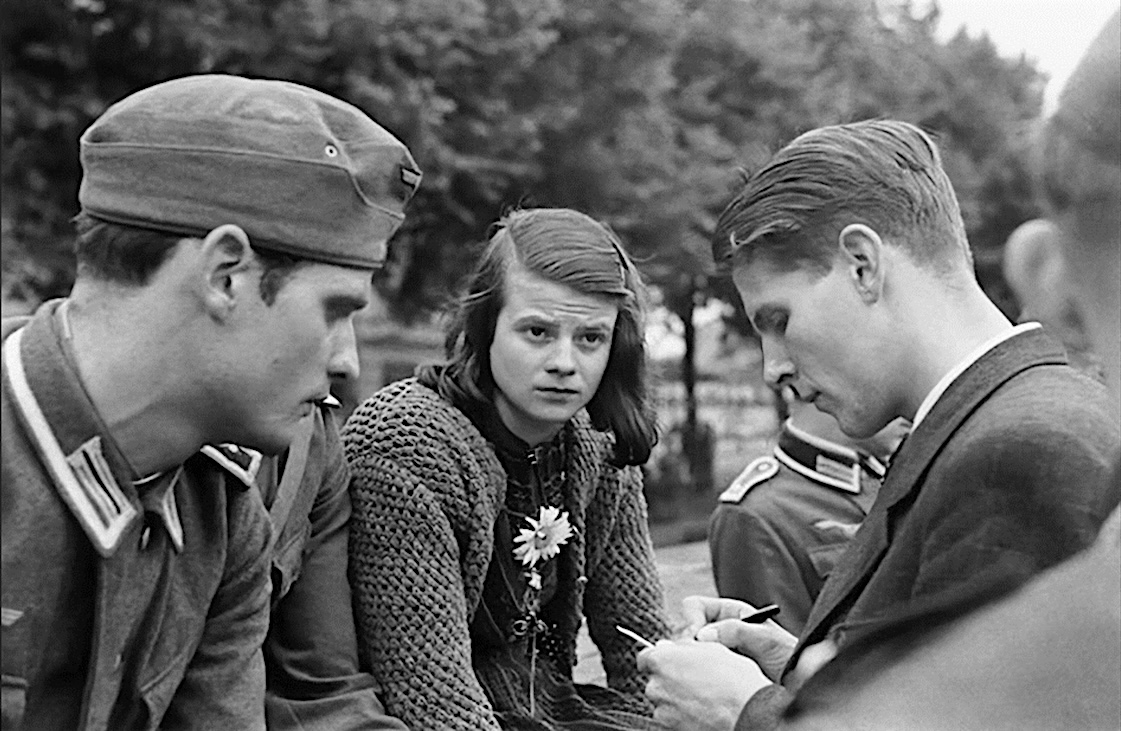
By this time, Sophie Scholl had completed six months of compulsory service in a government work program. Gifted with young children, she also taught in a kindergarten. Like her brother, Sophie had intended to study medicine at the University of Munich. But she was soon inspired by Hans and his Catholic friends to study art, religion, and philosophy.
Although Sophie did not write any of the White Rose leaflets, she obtained the means to produce and deliver them: the mimeograph, the postage stamps, and the train tickets that were used to print the leaflets and distribute them around the country. Sophie volunteered for these assignments because she and her friends believed that a young woman would be less likely to be randomly stopped, detained, and interrogated by security services than a young man not in uniform.
Quoting Madeleine Delbrel, Pope Francis recently said: “The place that Christian hope assigns us is that narrow ridge, that borderline, at which our vocation requires that we choose, every hour and every day, to be faithful to God’s faithfulness to us.” In this spirit, Sophie Scholl’s vocation, her narrow bridge and her borderline, was to walk the treacherous path of conscience with faith, hope, and courage, ever devoted to God and his Golden Rule.
History does not record much more about Sophie’s work with the White Rose until February 18, 1943. On that day, Hans and Sophie traveled across Munich to Ludwig Maximillian University. They carried a suitcase that contained the sixth and last printed leaflet of the White Rose. This one exhorted German young adults to leave the Nazi Party and to engage in non-violent resistance.
After invoking the disastrous defeat of the German army at Stalingrad, the leaflet read in part: “We demand genuine learning and real freedom of expression. No threats can terrorize us…This is the struggle of each and every one of us for our future, our freedom, and our honor under a regime unconscious of its moral responsibilities.” The leaflet continued: “Freedom and honor! For ten long years, Hitler and his thugs have manhandled, squeezed, twisted, and debased these two splendid German words to the point of nausea, as only dilettantes can, casting our highest values before swine.”
Hans and Sophie dropped stacks of leaflets in empty corridors. Just as classes were being dismissed and the corridors of the lecture hall were filling with students, Sophie flung the remaining leaflets from the top floor of an atrium. She was spotted by a custodian who was a Nazi loyalist. Hans and Sophie were soon detained by the Gestapo.
On February 22, 1943, Hans, Sophie, and Christoph Probst were found guilty of treason and thereafter beheaded. During the five days between her arrest and execution, Sophie Scholl impressed the guards, the prosecution, and her fellow prisoners. She was calm. She was at peace with her life and her certain death. At the trial, Sophie told the court: “Someone had to make a start. What we said and wrote is believe by so many people. They just did not dare express themselves.” She then said: “I believe, now as before, that I did my best for my country. Therefore, I do not regret my conduct, and I will bear the consequences that result from it.”
Sophie Scholl’s last words are disputed. In a letter to Hans and Sophie’s father, Else Gebel, a fellow prisoner, recorded these as her final thoughts: “How can we expect righteousness to prevail when there is hardly anyone willing to give themselves up for a righteous cause.” In the end, historians believe that Sophie Scholl’s actual last words reflect a certain hope, a deepening faith, and a promising life’s journey cut short by a cruel and petty tyrant. Before serenely entering the shed that contained the instrument of her execution, Sophie looked up at the midwinter sun. She cried out: “O God, my refuge unto eternity!” Sophie Scholl (1921-1943) was a martyr for courage and conscience. Sophie Scholl was a pilgrim of hope.
Glory to the Father, to the Son, and to the Holy Spirit; as it was in the beginning, is now, and will be forever. Amen. Saint Francis of Assisi, pray for us! Saint Clare of Assisi, pray for us! Our Lady of the Angels, pray for us!
ABOUT THE AUTHOR
Brother Patrick Garvey is co-founder and spiritual director of the Assisi Project. He is a graduate of the University of Southern Maine, Saint John Seminary, and the Catholic University of America. He is a writer, spiritual director, retreat leader, and university lecturer. He also serves as an Associate Minister in the Catholic Community of Gloucester & Rockport in Massachusetts. On October 3, 2023, the Feast of the Transitus of Saint Francis of Assisi, Brother Patrick was consecrated as a diocesan hermit by Bishop Mark O’Connell, Vicar General of the Archdiocese of Boston. For more information about the Assisi Project and our ministries with adults of all ages and backgrounds, please contact Brother Patrick at brpatrick@assisiproject.com.
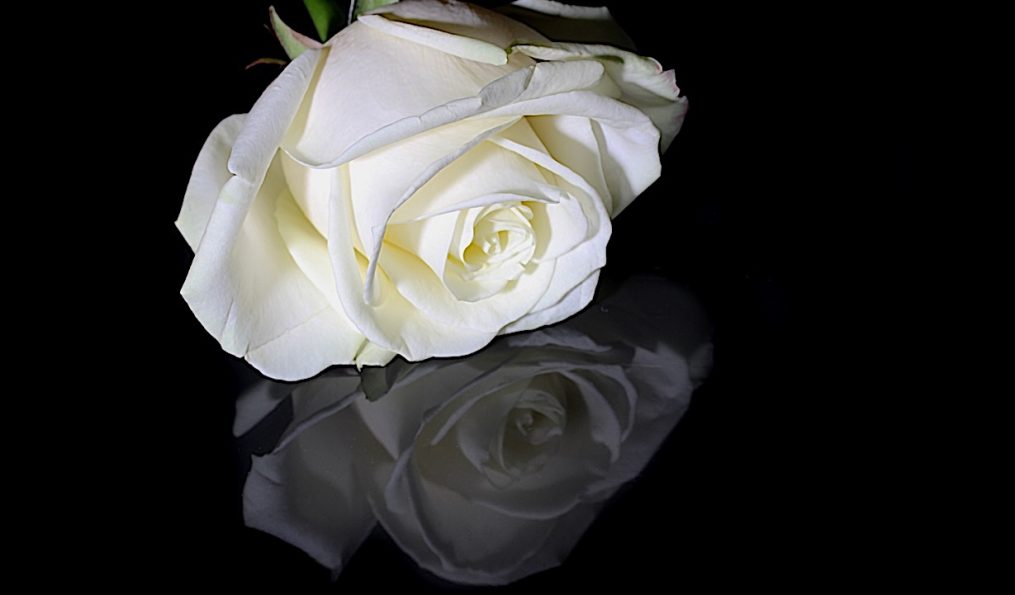
Art Credit: White Rose by Lynda Jayne – 8152760 – Dreamstime
Art Credit: Sophie Scholl by Alpha Historica – Alamy
__________
ABOUT US
Founded in 2007, the Assisi Project is a Fellowship of Franciscans in Spirit with friends and followers throughout the world. We are dedicated to helping Christian believers of all ages more faithfully live the Gospel of Christ in the spirit of Saint Francis and Saint Clare of Assisi. The Assisi Project is a non-profit, tax exempt charitable organization. Please support our ministry via Pay Pal (see link below) or mail a tax-deductible donation to the Assisi Project, Post Office Box 3158, Gloucester, Massachusetts 01931-3158. The Assisi Project Podcast is produced by the Assisi Project, Inc. Copyright 2025. All rights reserved. May God bless you! May the Lord give you peace!
Support us via PayPal
Follow us on BlueSky
Follow us on Instagram
This Week’s Homepage
In Memory of Members of the White Rose
 The Assisi Project