 SAINTS FOR ALL SEASONS
SAINT JOSEPHINE BAKHITA
By Brother Patrick
On May 17, 1992, Pope John Paul II presides over the Beatification of Josephine Bakhita (1869-1947). The Holy Father says: “In our time, when the unbridled race for power, money, and enjoyment causes so much distrust, violence, and loneliness, Sister Bakhita is given to us by the Lord as a universal sister, so that she may reveal to us the secret of true happiness.” These words beg two questions: Who is Saint Josephine Bakhita? What does it mean to be a universal sister?
She is born in Sudan, Africa in 1869. Her family is not rich, but well-respected in their village. Her family is large and loving: three brothers and three sisters. About the family she says: “I lived a happy and carefree life. I did not know suffering.” But in 1877, she is kidnapped by slave traders. She is just eight years old. Over the course of the next twelve years, she is bought and sold three times. She does not remember her village. She does not remember her family. She does not remember her name.
One of the slavers calls her “Bakhita” which means “lucky” in Arabic. She is forced to convert to Islam. One owner beats her and mutilates her breasts. Another owner abuses her with a whip. Bakhita says later: “I do not recall a single day without being wounded in some way.” Bakhita’s body is further disfigured by tattooing and scarification. Scarification involves burning, etching, or scratching words, designs, or images into the skin. More than one hundred patterns are cut into her breasts, stomach, and right arm. Untreated wounds caused by scarification can heal in six to twelve months. But salt is rubbed into Bakhita’s wounds, which makes her suffering more severe and long lasting.
In 1883, Bakhita is purchased by Callisto Legnani, an Italian diplomat who is stationed in Sudan. The family is kind to her. In 1884, Legnani takes Bakhita to Italy. In 1885, he gives Bakhita to the Michieli family of Venice. This family, too, is kind to her. She becomes a beloved nanny to their children. In 1888, the Michieli family travels to Africa. Bakhita is left with a religious order, the Canossian Daughters of Charity.
From these sisters, Bakhita learns to speak Italian. She learns to read. She learns to write a bit. She learns to pray, trust, and forgive. She learns to be kind, humble, and courteous. She learns that a life freely given for others can be a life of joy and peace. She learns about Christianity. She becomes a believer. Bakhita says: “Those holy mothers instruct me with heroic patience. They introduce me to that God, who from childhood, I felt in my heart without knowing who He was.”
In 1889, the Michieli family seeks to regain custody of their slave. But Bakhita refuses. In her defense, the Canossian Sisters appeal to the Patriarch of Venice and the Attorney General of Italy. A court determines that slavery is illegal in Sudan at the time of Bakhita’s birth. It also declares that slavery is never legal in Italy. For the first time, Bakhita is free! For the first time, Bakhita can choose her own destiny!
Bakhita discerns a call to the consecrated life. In December 1893, she enters the Canossian novitiate. She is baptized as Josephine Margaret Fortunata. Fortunata is the Italian translation of Bakhita. She is fortunate. She is lucky. She is now truly blessed. Sister Josephine Bakhita takes vows of poverty, chastity, and obedience. In 1902, she moves to the Canossian Convent at Schio in a northern province of Italy. Except for missionary trips, she remains there for the rest of her life.
Bakhita serves as cook, doorkeeper, and sacristan. She becomes well known in the local community. She spends long hours in prayer before the Crucifix and Blessed Sacrament. One of her sisters says: “Her faith is simply radiant.” The townspeople are drawn to her deep faith, soft voice, easy smile, and gentle demeanor. They come asking for advice. They come asking for prayers. They come looking for comfort and consolation.
During the Second World War, Bakhita promises that they will be safe from aerial bombings. And although bombs fall on the town, no one is killed. The people believe that Bakhita’s prayers save them. In response, she says: “Now my mission is this: to help everyone by way of prayer.” To all those who seek her out for prayer and spiritual counsel, she says: “Take heart. I am praying for you.”
Bakhita’s faith inspires her to love and serve the Poor Christ. Her faith empowers her to love and forgive others — even the torturers, even the slave traders. She says: “If I were to meet those who kidnapped me, even those who tortured me, I would kneel and kiss their hands…For if these things had not happened, I would not be a Christian now.”
During her final years, old injuries take their toll. Bakhita suffers constant pain. She needs a wheelchair to move around the convent. She dies on February 8, 1947. Her last wish is to be buried in her “most well-worn habit.” Her coffin is to be constructed from old boards that are salvaged from the buildings destroyed during the war. Bakhita is hailed almost immediately as a saint.
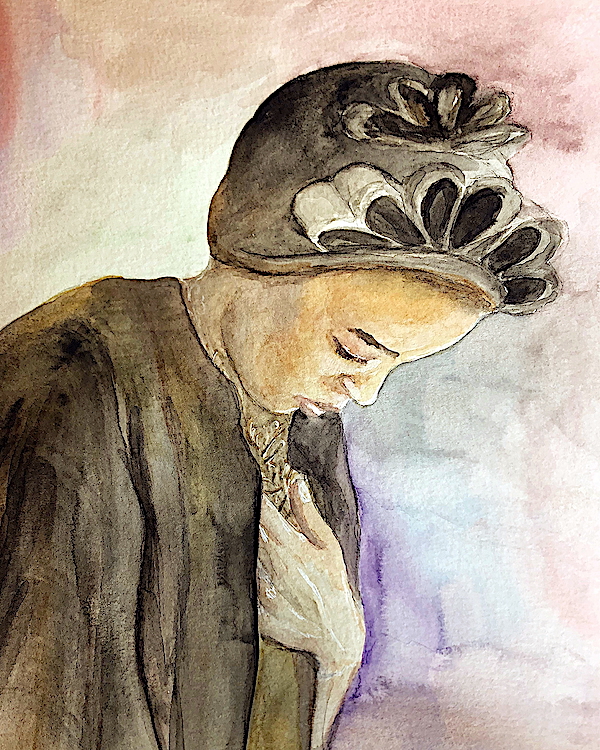
In May 1992, Pope John Paul II beatifies her. In October 2000, he canonizes her. The pope calls her life “a message of heroic goodness.” He calls her a woman “devoured by the fever of love.” And he calls her our “universal sister.” To be universal is to be common, all-inclusive, all-embracing, all-encompassing. To be universal is to share in the life and experience of all people, in all places, at all times. About Saint Josephine Bakhita, one Conossian sister says: “People feel that she is their friend. They see her as a model to follow on the journey of faith. For all of us, Bakhita is proof that a daughter of Africa can become a symbol for the whole world.”
In faith, in friendship, in the Lord’s vineyard, and on the journey of life, Bakhita is our universal sister. In good times, in hard times, in forgiving every insult, in counting every blessing, Bakhita is our universal sister. Cardinal Gabriel Wako serves as Archbishop of Khartoum in Sudan from 1979 until 2016. He says: If you are persecuted: “You are Bakhita.” If you carry a heavy cross in this life: “You are Bakhita.” If you are poor in body, mind, or spirit: “You are Bakhita.”
In our pain, in our affliction, in our alienation from one another, she weeps with us. Bakhita is our universal sister. She hears the cries of those who suffer. She answers those cries with her petitions. She prays with us. She prays for us. Bakhita is our universal sister. Cardinal Wako says: “Bakhita prays for everyone. She will never stop praying for you…She will never forget you.”
In our day, as hatred and division create unspeakable hardships for the poor, the sick, and the stranger, we need our universal sister now more than ever. In our grief, in our guilt, in our poverty, and in our hope for better days, we pray:
Most High God,
giver of all good gifts,
you blessed us with Saint Josephine Bakhita
as our universal sister:
a model of deep faith,
boundless hope, and humble charity.
By her powerful prayers,
inspire us to live the Gospel,
share your love and mercy,
and rebuild your Church.
We ask this through the Poor Christ,
our merciful redeemer, friend, and brother,
who lives and loves with you and the Holy Spirit;
God for always and evermore. Amen.
Saint Josephine Bakhita, pray for us!

ABOUT THE AUTHOR
Brother Patrick Garvey is co-founder and spiritual director of the Assisi Project. He is a graduate of the University of Southern Maine, Saint John Seminary, and the Catholic University of America. He is a writer, spiritual director, retreat leader, and university lecturer. He also serves as an Associate Minister in the Catholic Community of Gloucester & Rockport in Massachusetts. On October 3, 2023, the Feast of the Transitus of Saint Francis of Assisi, Brother Patrick was consecrated as a diocesan hermit by Bishop Mark O’Connell, Vicar General of the Archdiocese of Boston. For more information about the Assisi Project and our ministries with adults of all ages and backgrounds, please contact Brother Patrick at brpatrick@assisiproject.com.
Art Credit: Leanne Bowen Fine Art
__________
ABOUT US
Founded in 2007, the Assisi Project is a Fellowship of Franciscans in Spirit with friends and followers throughout the world. We are dedicated to helping Christian believers of all ages more faithfully live the Gospel of Christ in the spirit of Saint Francis and Saint Clare of Assisi. The Assisi Project is a non-profit, tax exempt charitable organization. Please support our ministry via Pay Pal (see link below) or mail a tax-deductible donation to the Assisi Project, Post Office Box 3158, Gloucester, Massachusetts 01931-3158. The Assisi Project Podcast is produced by the Assisi Project, Inc. Copyright 2025. All rights reserved. May God bless you! May the Lord give you peace!
Support us via PayPal
Follow us on BlueSky
Follow us on Instagram
This Week’s Homepage
For Peace & Fraternity in Sudan
 The Assisi Project