BECOMING PILGRIMS OF HOPE
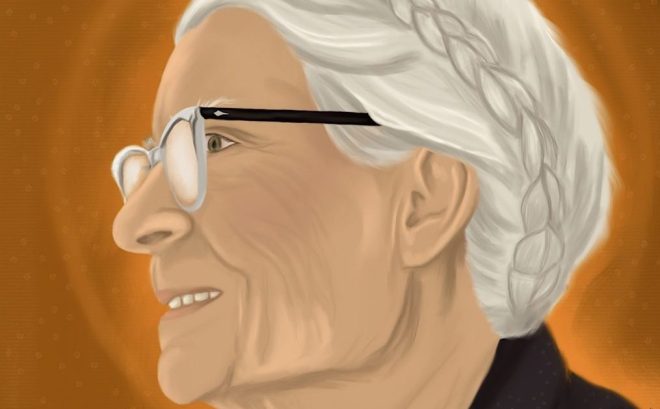
DOROTHY DAY
By Brother Patrick
Francis Sempa writes: “The optimists among us, who believe in the inevitable progress of man, either forget or ignore the fact that the twentieth century was the bloodiest, most destructive century in human history. The century’s two world wars resulted in the deaths of at least sixty million people. The Russian Civil War of 1917-1921 killed another five to six million people. Between them, the tyrannical regimes of Hitler, Stalin, and Mao killed at least another sixty million of their own citizens. Many millions more were killed in dozens of other, smaller conflicts.” The calamity of twentieth century war was compounded by the violence associated with poverty, persecution, the struggle for liberation, and the competing Cold War ideologies of capitalism and communism.
In the midst of these times, a Servant of God lived and worked, loved and lectured, prayed and protested. Dorothy Day was born in Brooklyn in 1897. A biographer, Patrick Jordan writes: “Dorothy Day was ‘made in America.’ She had grandparents who fought on both sides of the Civil War. She lived in all four quadrants of the United States: east, west, north, and south, and she understood America’s people and its history (Love in Action, 13).”
As a young adult, Dorothy Day found work as a journalist in New York City. She wrote for radical newspapers that shared these common principles: peace, justice for the poor, social and economic reform. Dorothy Day was an avid reader. She loved the novels of Dickens and Dostoyevsky. These and other authors helped her to see and appreciate the plight of the poor, the workers, and the immigrants of her time. She condemned the atheism and tyranny of the Soviet Union. She also condemned the cruelty and cold materialism of American capitalism.
Dorothy Day was an activist, diarist, and journalist. She was an anarchist. She was a socialist. She was a pacifist. She was a protester. Dorothy Day was also a person of faith. She read from the gospels every day. She read from the lives of the saints every day. She prayed the rosary every day. She prayed with the psalms every day. And she prayed constantly for faith and perseverance. She was devoted to the voluntary poverty of Saint Francis of Assisi. She was devoted to the Little Way of Saint Therese of Lisieux.
On May 1, 1933, during the darkest days of the Great Depression, Dorothy Day and Peter Maurin, her friend and mentor, co-founded the Catholic Worker Movement. The Catholic Worker was built upon twin pillars from the Gospel of Matthew: the Lord’s Sermon on the Mount (Matthew 5-6) and the Lord’s Discourse on the Mount of Olives (Matthew 25).
The Catholic Worker began as a newspaper that sold, then and now, for one penny per copy, so that almost anyone could afford it. The paper preached a message of peace and social justice. Exercising a prophetic voice, it was among the first to protest the gathering storm of fascism; among the first to oppose Nazi Germany’s persecution of the Jews; among the first to oppose the use of nuclear weapons; among the first to oppose the Korean and Vietnam Wars; and among the first to give full voice to Catholic Social Teaching and its preferential option for the poor. Then one day, people started showing up at the newspaper’s offices in search of food, clothing, and shelter. This began the movement’s ministry of offering daily meals and hospitality to those in need.
As mother of the Catholic Worker, Dorothy Day could be surly, stubborn, and demanding. She could be fierce and impatient. She sometimes held grudges. Dorothy Day was also courageous. She was not afraid to speak truth to power. She paid local taxes. But she refused to pay federal taxes because the revenue bought the weapons of war. She declined to apply for Medicare. She declined to apply for Social Security. She declined to incorporate the Catholic Worker as a tax-exempt, non-profit charity. She refused donations from corporations and foundations. She relied on the generosity of people just like you and me. She relied on pennies from heaven. A friend said about her: “Dorothy is not a saint. She is a warrior.”
Dorothy Day died of a heart attack on November 29, 1980. Her tombstone reads simply (in Latin): “Thanks be to God.” Nearly two hundred Catholic Worker communities carry on her work. They remain committed to peace, prayer, and non-violent protest. They feed the hungry, clothe the naked, shelter the homeless, and welcome the stranger. They continue to protest war, racism, injustice, and inequality. For five decades, Dorothy Day spent herself on the work of loving God and loving neighbor. These are her words:
The first job of the Christian…is to grow in faith in God, in his power, in the conviction that we are all held in the hallow of his hand.
God is nothing else but love.
Keep asking for his love.
We must love only God. And that sets up the triangle: God, the soul, and the world.
We have the greatest weapons in the world, greater than any hydrogen or atom bomb, and they are the weapons of poverty and prayer, fasting and alms, the reckless spending of ourselves in God’s service and for his poor.
I am convinced that prayer and austerity, prayer and self-sacrifice, prayer and fasting, prayer and vigils, and prayer and marches are the indispensable means…and love.
My prayer from day to day is that God will so enlarge my heart that I will see you all, and live with you all, in his love.
If you love, you want to give yourself.
To be simple like little children, to live in the presence of God, to love God in his creatures, to do away with all suspicion, anger, contention, and lack of brotherly love, to do the little things each day as well as we can and to start it all over again each morning, refreshing ourselves, steeling our wills, this is all we need to keep in mind.
Our lives must be a pure act of love repeated many times over.
Take away my heart of stone and give me a heart of flesh, so that I may learn how to truly love my brother because in him, in his meanest guise, I am encountering Christ.
We must love our enemy, not because we fear war, but because God loves him.
As long as there is any resentment, bitterness, or lack of love in my own heart, I am powerless. God must help me.
Our God is a consuming fire in what he expects from us: the impossible.
How to love? That is the question. The solution proposed in the gospels is that of voluntary poverty and works of mercy. It is the little way. It is within the power of us all. Everybody can begin here and now.
We have got to pray, to read the gospel, to get frequent communion, and not judge, not do anything but love, love, love.
Love and ever more love is the only solution to every problem that comes up. If we love each other enough, we will bear with each other’s faults and burdens. If we love enough, we are going to light that fire in the hearts of others. And it is love that will burn out the sins and hatreds that sadden us. It is love that will make us want to do great things for each other.
I believe some people, lots of people, pray through the witness of their lives, through the work they do, the friendships they have, the love they offer people, and receive from people.
If we could only learn that the only important thing is love, and that we will be judged on love…It is a hard, hard doctrine.
Let us respect each other as well as love each other.
At death, we are going to join God with the amount of love we have gathered for him. What we have when we die, we will have for all eternity.
So joy and suffering go together, pleasure and pain, work and rest, the rhythm of life, day succeeding night, spring following winter, life and death and life again, world without end.
Glory to the Father, to the Son, and to the Holy Spirit; as it was in the beginning, is now, and will be forever. Amen. Servant of God, Dorothy Day, pray for us! Saint Francis of Assisi, pray for us! Saint Clare of Assisi, pray for us! Our Lady of the Angels, pray for us! Pope Francis, pray for us!
ABOUT THE AUTHOR
Brother Patrick Garvey is co-founder and spiritual director of the Assisi Project. He is a graduate of the University of Southern Maine, Saint John Seminary, and the Catholic University of America. He is a writer, spiritual director, retreat leader, and university lecturer. He also serves as an Associate Minister in the Catholic Community of Gloucester & Rockport in Massachusetts. On October 3, 2023, the Feast of the Transitus of Saint Francis of Assisi, Brother Patrick was consecrated as a diocesan hermit by Bishop Mark O’Connell, Vicar General of the Archdiocese of Boston. For more information about the Assisi Project and our ministries with adults of all ages and backgrounds, please contact Brother Patrick at brpatrick@assisiproject.com.
Art Credit: Dorothy Day by SimplyJoyfulPrint – Etsy.com
__________
ABOUT US
Founded in 2007, the Assisi Project is a Fellowship of Franciscans in Spirit with friends and followers throughout the world. We are dedicated to helping Christian believers of all ages more faithfully live the Gospel of Christ in the spirit of Saint Francis and Saint Clare of Assisi. We are also dedicated to promoting a devotion to Pope Francis (1936-2025) as a patron of peace, mercy, and fraternity in our sick and suffering world.
The Assisi Project is a non-profit, tax exempt charitable organization. Please support our ministry via Pay Pal (see link below) or mail a tax-deductible donation to the Assisi Project, Post Office Box 3158, Gloucester, Massachusetts 01931-3158. The Assisi Project Podcast is produced by the Assisi Project, Inc. Copyright 2025. All rights reserved. May the Lord give you peace!
Support us via PayPal
Follow us on BlueSky
Follow us on Instagram
This Week’s Homepage
For the Courage to Remember the Poor
 The Assisi Project