SAINTS FOR ALL SEASONS
SAINT LAZARUS OF BETHANY
By Brother Patrick
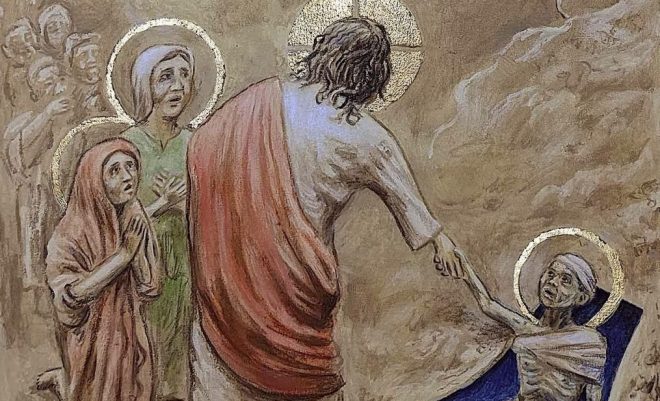
Jesus arrives in Bethany, a Judean village near Jerusalem, at the base of the Mount of Olives (See John 11:1-44). He knows in his heart or he learns from friends and family that Lazarus, his good friend, is dead. Martha and Mary, dear friends and sisters of Lazarus are distraught and disappointed that Jesus did not come more quickly. Jesus says to Martha: “Your brother will rise.” Jesus sees Martha’s tears. He sees Mary’s tears. He sees the tears of the assembled villages. He also sees his enemies. And so, Jesus weeps. Everyone sees his grief and his unease. The crowd knows that Jesus loved Lazarus. The skeptics whisper that Jesus, who healed others, should have healed his friend.
Jesus then approaches the tomb. He says: “Take away the stone.” He prays to God and gives God thanks. He prays for the skeptics. He prays that they might believe. Then Jesus cries: “Lazarus, come out!” Lazarus, bound by burial bands, emerges from the tomb. He is alive. He is risen. Jesus then says simply: “Let him go.” This is not the Lord’s first miracle. But it is the miracle that confirms the faith of his followers. It is the miracle that confounds his doubters. It is the miracle that enrages his enemies. The conspiracy to crucify Jesus begins now.
But who is Lazarus? What becomes of him? Lazarus is not an apostle. He is a disciple. He is a friend. He is a close friend. Perhaps he is the Lord’s best friend. In his book, Come Forth: The Promise of Jesus’s Greatest Miracle, Father James Martin, SJ asks timeless questions: What happens next? Does Lazarus live a long and happy life? Does he become an evangelist? Does he become a living witness of the Lord’s power? Does he have children and grandchildren who share the miracle with future generations? The Gospel of John does not answer any of these questions. John offers only two further facts about Lazarus. First, he is alive and present at a meal with Jesus, Martha, and Mary after being raised from death. Second, the Lord’s enemies begin their plot to kill Jesus and perhaps also Lazarus.
So what happens next? One theory is that Lazarus never dies a second death. However fanciful, this theory leads us to speculate that Lazarus still walks the earth. He is a lonely figure. He sees every folly in human history. He longingly awaits the Lord’s second coming on the Last Day. Another theory holds that Lazarus is soon murdered by the same people who murder his friend, Jesus. One scripture scholar, Father Francis Moloney, writes: “Jesus’s enemies decide that both Jesus and Lazarus have to die because of the amazement and wonder generated by the spectacular miracle of the Raising of Lazarus.”
Such theories are proposed by modern scripture scholars and speculative theologians. Tradition teaches something else. Eastern tradition holds that Lazarus flees from his home in Bethany out of fear for his new life. Eventually he lands in Cyprus. By this time, Paul and Barnabas are in Cyprus on their first missionary journey which is recounted in the Acts of the Apostles.
This tradition teaches that Paul and Barnabas ordain Lazarus as first bishop of Kition. During this time, Lazarus never smiles. Lazarus is forever mournful over what he sees while walking among the dead. Lazarus serves as bishop for thirty years, then dies again. For centuries, his tomb is lost, but in 890, it is discovered bearing this simple inscription: “Lazarus, four days dead, friend of Jesus.” Leo the Wise (866-912), a Byzantine Emperor transfers the saint’s relics to Constantinople but builds the Church of Saint Lazarus over the site of his original, now empty tomb.
Meanwhile, western tradition holds that Lazarus, Martha, and Mary suffer persecution. They are set adrift in a boat with oar, sail, or rudder. They drift across the sea and land at Marseilles in France. Lazarus is hailed as the city’s first bishop. By his preaching and witness, he converts countless people. At one point, Lazarus hides in a tomb (of all places) in order to escape Nero’s persecution of the Church. But years later, Lazarus emerges and is martyred by a new emperor called Domitian. According to this tradition, the head of Lazarus remains in Marseilles. His remaining relics are sent to a village in central France where a cathedral is built in his honor during the 12th century.
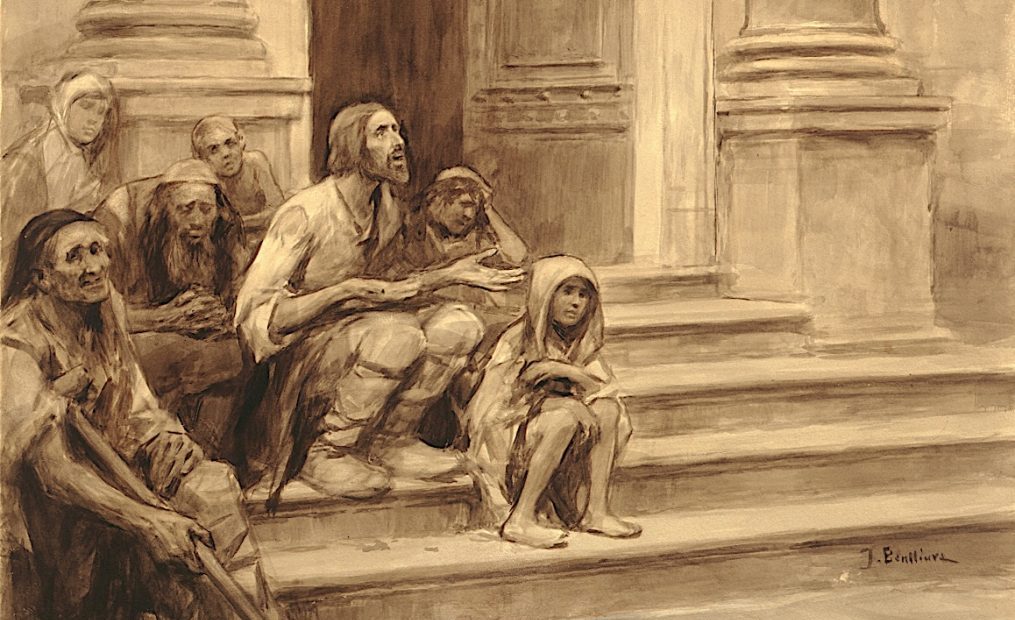
In our time, Saint Lazarus of Bethany is venerated as a patron of the poor, the sick, and the dying. In sacred art, he is depicted as an apostle; in the bands of his burial; in the vestments of a bishop; or clothed in white: the color of holiness and purity, the color of life, light, and resurrection.
In his book, Father James Martin, SJ suggests that Saint Lazarus is something of a universal patron to all of us; to all of us who need to let go of some grudge, some idol, some addiction, or some sinful behavior that keeps us from being who God calls us to be. Father Martin writes: “Lazarus represents all of humanity, and so all of humanity is called to hear Jesus’s voice (184).” Father Martin then says: “Whatever needs to die needs to be left behind. Jesus wants to invite [us] into new life, but first [we] must be willing to leave behind those things in the tomb (296).” And finally: “Each one of us is ‘Lazarus’: the ‘friend’ of Jesus, ‘the one whom he loved (299).'”
The Feast of Saint Lazarus of Bethany is now celebrated on July 29th as the Feast of Saints Martha, Mary, and Lazarus. But before the Second Vatican Council, the Feast of Saint Lazarus of Bethany is celebrated on December 17th, which is also the birthday of our beloved Pope Francis (1936-2025). In a spirit of faith, hope, love and communion, we now pray:
A Prayer for the Intercession of Saint Lazarus of Bethany
Lord Jesus,
you are friend and brother,
savior and redeemer,
resurrection and life.
You raise Lazarus from death
as a sign of your power and glory:
as a sign of your love, mercy, and fraternity
with all of God’s children.
We pray that Saint Lazarus,
your faithful friend and disciple,
patron of the poor and the sick,
will intercede for us with you
at the right hand of the Father. Amen.
Glory to the Father, to the Son, and to the Holy Spirit; as it was in the beginning, is now, and will be forever. Amen. Saint Lazarus of Bethany, pray for us! Saint Martha & Saint Mary, pray for us! Mary, Mother of Jesus, pray for us!

ABOUT THE AUTHOR
Brother Patrick Garvey is co-founder and spiritual director of the Assisi Project. He is a graduate of the University of Southern Maine, Saint John Seminary, and the Catholic University of America. He is a writer, spiritual director, retreat leader, and university lecturer. He also serves as an Associate Minister in the Catholic Community of Gloucester & Rockport in Massachusetts. On October 3, 2023, the Feast of the Transitus of Saint Francis of Assisi, Brother Patrick was consecrated as a diocesan hermit by Bishop Mark O’Connell, Vicar General of the Archdiocese of Boston. For more information about the Assisi Project and our ministries with adults of all ages and backgrounds, please contact Brother Patrick at brpatrick@assisiproject.com.
Art Credit: The Raising of Lazarus (Detail) by Stefan Salina – stefansalinas.com
__________
ABOUT US
Founded in 2007, the Assisi Project is a Fellowship of Franciscans in Spirit with friends and followers throughout the world. We are dedicated to helping Christian believers of all ages more faithfully live the Gospel of Christ in the spirit of Saint Francis and Saint Clare of Assisi. We are also dedicated to promoting a devotion to Pope Francis (1936-2025) as a patron of peace, mercy, and fraternity in our sick and suffering world.
The Assisi Project is a non-profit, tax exempt charitable organization. Please support our ministry via Pay Pal (see link below) or mail a tax-deductible donation to the Assisi Project, Post Office Box 3158, Gloucester, Massachusetts 01931-3158. The Assisi Project Podcast is produced by the Assisi Project, Inc. Copyright 2025. All rights reserved. May the Lord give you peace!
Support us via PayPal
Follow us on BlueSky
Follow us on Instagram
This Week’s Homepage
For the Courage to Leave It Behind
 The Assisi Project